


Using a personalized cultural probe, I explored what the ebbs and flows of emotion can uncover about a person’s alignment with their values
Probe
Click each icon to discover a different activity
Journal
Boxing feelz
Spin the wheel
Journal. The main anchor. Every day, Nara will open the journal to a new page representing the activities and prompts of the day. Every entry has a designated space for written reflection.
Days
Mandatory activities
Optional activities
Purpose
Day 1
Boxing feelz.
Journaling. Reflect on the past week. Any emotions that stand out?
Create a point of reference for the emotions of the week of the cultural probe.
Keep track of the emotions of the day
Day 2
Boxing feelz.
Spin the wheel.
Journaling. Anything else you’d like to share about your day?
Keep track of the emotions of the day
Add variety and fun to the week
Day 3
Boxing feelz.
Spin the wheel.
Journaling. What surprised you today?
Keep track of the emotions of the day
Understand a little more about what surprise is related to for Nara
Day 4
Boxing feelz.
Spin the wheel.
Journaling. If you had to describe your experience (the one you landed on in the wheel) using an image, what would it be?
Keep track of the emotions of the day
Switch things up a bit to add variety to the probe through the activity of the wheel
Understand more about how Nara visualizes her experiences
Day 5
Boxing feelz.
Journaling. What are you grateful for today?
Spin the wheel.
Keep track of the emotions of the day
Understand what brings Nara feelings of gratefulness
Day 6
Nothing
A space to share anything my informant would like to add in any shape or form
Get complementary insight that may not have been captured by specific prompts
Set of questions
Describe your daily life
What can be difficult on a daily basis?
What keeps you on Instagram?
What are you involved in at Minerva?
Where do you see yourself after a Minerva?
Why the EU or the US?
What is your core belief or what are your core beliefs?
What’s your motivation for your work in general?
Interview synthesis
Nara often starts her day between 7:00 a.m. to 11:00 a.m. with Instagram scrolling for dopamine, though she has been actively trying to change that behavior through redistributing communication channels across several platform
Despite a busy schedule, she yearns to explore more of Buenos Aires through activities like visiting museums and nature spots
Meaningful activities for her involve engaging with humans, hands-on experiences, and using Instagram as a public diary. The intersection of these activities remains uncertain for Nara
Her core beliefs have shifted from freedom to curiosity, fueled by a desire for knowledge
Notable follow-ups
Information obtained after follow-up questions focused on Nara's emotions
Nara's emotions color key
Joy

Anger

Disgust

Fear

Sadness

Surprise

Favorite animal

"Does a pegasus count? I used to like dolphins cuz Barbie, then I discovered they're kinda jerks in real life" - Nara
Design

Guiding statements
Nara places value in sharing her emotions and thoughts with others
Talking to people on deeper levels matters to Nara
Nara struggles with emotions and energy levels
Focus in a single word:
Emotions / Connections
Brainstorming


Key ideas. Emotion gauges, sharing emotions, connecting with others and nature, and a pegasus.
Daily prompts, first try
Assignment instruction: the probe should feature daily prompts
How could daily activities be done within a reasonable time frame? Let's take these key ideas and start thinking about what they could look like, informed by the interview.
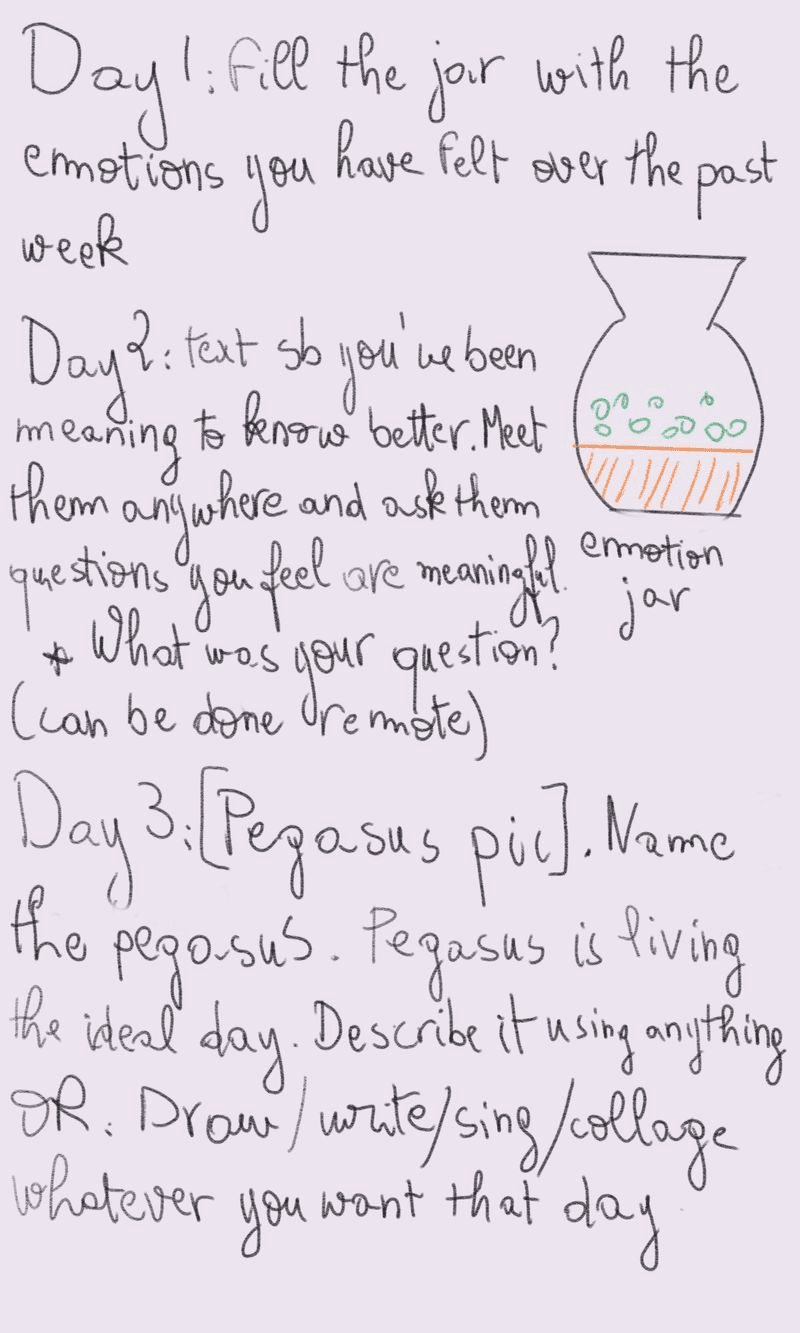


Hmm… The emotion jar idea risks heavy bias: the informant might try to ‘fix the pattern’ instead of honestly recording feelings. Recency bias is also a risk.
How do I keep emotional tracking more blind (and more fun)?

Enter the emotion box!
Every day, Nara will log a total of 6 cards chosen among 6 sets of emotion cards to represent her emotions for the day. For instance, if she was mostly happy with a little bit of sadness, she would log 5 joy cards and 1 sadness card.
Refinements
What are the origins of the Nara's emotions?
Nara logging plain emotion cards into the emotions box doesn't help me identify the origins of her emotions

Nara writes 1-2 keywords/phrases on each card before logging them to the emotion box
How can the journaling exercise be more effective?
The mandatory daily journaling prompt are too vague, time-consuming and repetitive

Journaling exercises feature a variety of prompts and are optional.

Nara is encouraged to use the colorful pens to help her untangle her emotions further and enrich the insights from the emotion box.
Anything to add to make the prompt more fun?

I added a wheel of mostly optional activities inspired by the interview. Nara will have the possibility to add her own activities should she choose to. Nara is encouraged to spin the wheel daily, and do one of the activities she lands on.
Cultural probe
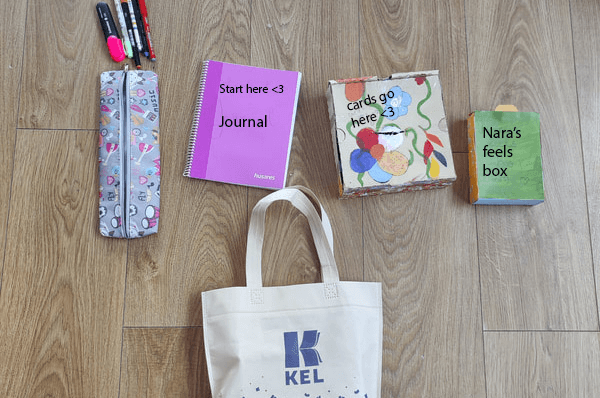
From left to right: pencil case with aid pens, journal, Emotion box, feels cards box
Participant presentation
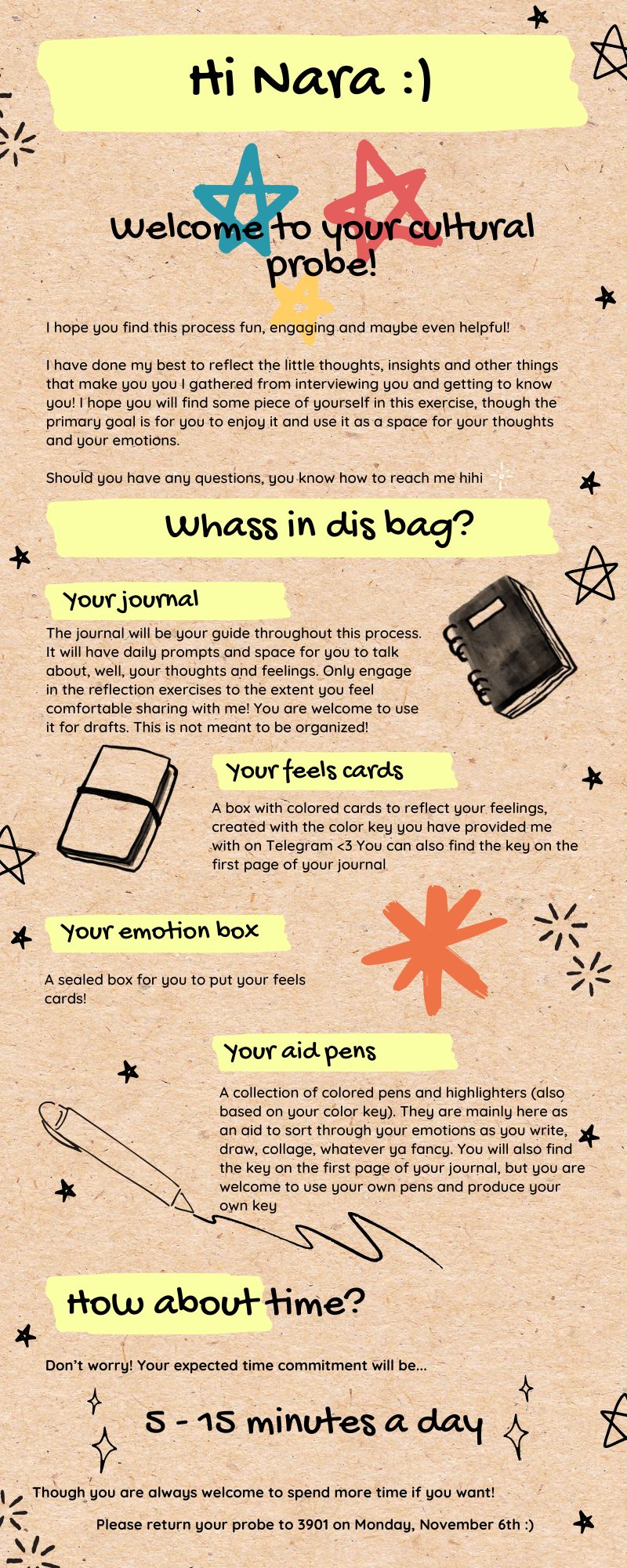

Have trouble reading?
Results
There is a disconnect between Nara's valuing of emotional connection and her frequent feeling of loneliness. Reading her journal, it looked like what alleviated such feelings was having direct, face-to-face conversations with loved ones rather than relying on text.
Emotional patterns
Informed by the journal entries, the cards and their visualization reveal the following patterns:
The combined word cloud for every day reveals two major emotions Nara’s week: joy (in the form of gratefulness) and sadness (in the form of loneliness).
The most prominent feelings that Nara attaches to joy are gratefulness, pride, and relief. Good food also seems to be important, and so does class attendance. Note that she notes on multiple occasion that she sees gratefulness as different from joy in the journal.
Loneliness, tiredness, and crying stand out in the sadness category.
There were relatively few anger cards, but the words that stand out have to do with her entry on being mad at the Economist and their outstanding bias against reporting on the Middle East – Nara takes social justice issues very seriously.
Disgust entries are mostly related to her physical appearance and feelings about her body. The words that stand out are “ugly” and “disgusting”.
Fear is mostly related to fear of academic failure. The word that stands out the most is the word “assignment”. We can also see future-related words coming out strong, such as “upcoming” and “dreading".
Surprise seems to be related to people doing nice things for Nara. The word “brought” comes in strong, and so is “Cynthia”, Nara’s friend. A few other words are worth noting: “sit” and “breathe” (being able to perform basic bodily functions after being sick) and “better” (Nara is often surprised that things are going well and not worse)

Bonus result. A toy gun Nara gave me because she felt she had a difficult week, and needed something more joyful in the mix
Future designs
In order to go beyond mundane conversations and towards meaningful ones that create a sense of connection, the app could have prompts for questions to talk about with her loved ones, such as “share something that recently upset you” or “what is something you recently learned about yourself?”
Since Nara has a busy schedule, the app could have a suggested timer starting at 5 minutes, perhaps with a gamified streak system with rewards, in order to encourage Nara to have these conversations regularly.
Careful consideration should be given to gamification ethics (as well as overall costs and benefits) should the design include that feature.
Takeaways
Emotional contradiction surfaced through self-reporting over time. Although Nara described herself as someone who values emotional connection, the probe revealed that loneliness was a recurring emotional undercurrent in her daily life. This contrast suggests that what people aspire to emotionally and what they experience day to day can diverge, a pattern that may not surface in an isolated interview.
Creative, low-pressure formats help participants articulate feelings that are hard to name explicitly. The emotion box, color, and open-ended writing revealed emotional nuances that would likely not emerge through direct questioning alone.
This probe offers depth, not generalization. With one participant, the goal was to uncover nuanced, contextual insight rather than broad trends. These findings act as starting points for future research and design, not universal conclusions.