How might we design an experience that helps neurotypical young adults better understand the lived experiences of neurodivergent people?
Project overview
This is the first of two prototypes exploring how design can build empathy for neurodivergent experience. I created Playing in Snow, a solo narrative text-based prototype that aims to immerse players in the emotional texture of masking (the experience of hiding neurodivergent traits under social pressure). The aim was to create an authentic, internal experience that prompts reflection from the neurotypical audience.
Contributions
I led Playing in Snow end to end, independently framing the problem, conducting research into academic literature and internet trends, designing the narrative experience, and conducting playtests to explore how empathy can emerge through constrained agency and introspective play.
Timeline
Part 1 & 2. October 2024 - May 2025 (8 months, part-time)
Highlights
Emotional resonance, with a caveat. Players reported moments of recognition and curiosity toward the story, but it depended on having had similar experiences.
Motivation
Neurodiversity. The idea that individuals perceive and engage with the world in diverse ways, recognizing that there is no single "correct" way to think, learn, or behave (Baumer & Frueh, 2021). Conditions include Autism, ADHD, dyslexia, and more.
Some statistics
Autistic people are more likely to die by suicide than non-autistic people, according to the past several years of research
TW — Suicide
The unemployment rate for neurodivergent people in the US is 30 to 40% compared to 10.1% of disabled people and a national average of 3.7% (John Hopkins University)
In 2021, the graduation rate at the University of California was 58% for neurodivergent students, compared to 79% for students without disabilities (Gauvain)
Why I care
As an experiential designer working with play and narrative, I’m exploring how design can surface invisible barriers and reshape how people understand one another. Neurodivergence is often discussed in terms of statistics, but rarely understood at a human level. I wanted to explore how design might help bridge that gap through lived, felt experience.
Research
After looking into the history and evolution of the neurodiversity movement and current discourse, I emerged with two key findings:
The Double Empathy Problem. The idea that neurodivergent people and neurotypical people struggle with understanding each other's ways of thinking. Formulated by Milton (2012).
The Empathy gap. The idea that much of the suffering that neurodivergent people face in various facets of their lives (e.g., access to education, medical bias, bullying) is due to the lack of empathy on behalf of the neurotypical majority. My formulation, after research
Double Empathy problem
Empathy gap
How might we design an experience to foster greater neurodivergence inclusion?
How might we design an experience that helps neurotypical young adults better understand the lived experiences of neurodivergent people?
Why neurotypical young adults?
Responsibility falls more heavily on neurotypical folks due to the history of stigma and marginalisation
Focused on young adults because they were the most accessible audience within the context of this project
Design
I compiled a list of common experiences of neurodivergence, and decided masking would be the focus of the experience
Masking. Hiding neurodivergent traits to blend in in social situations, often at a great cost of energy
Brainstorming
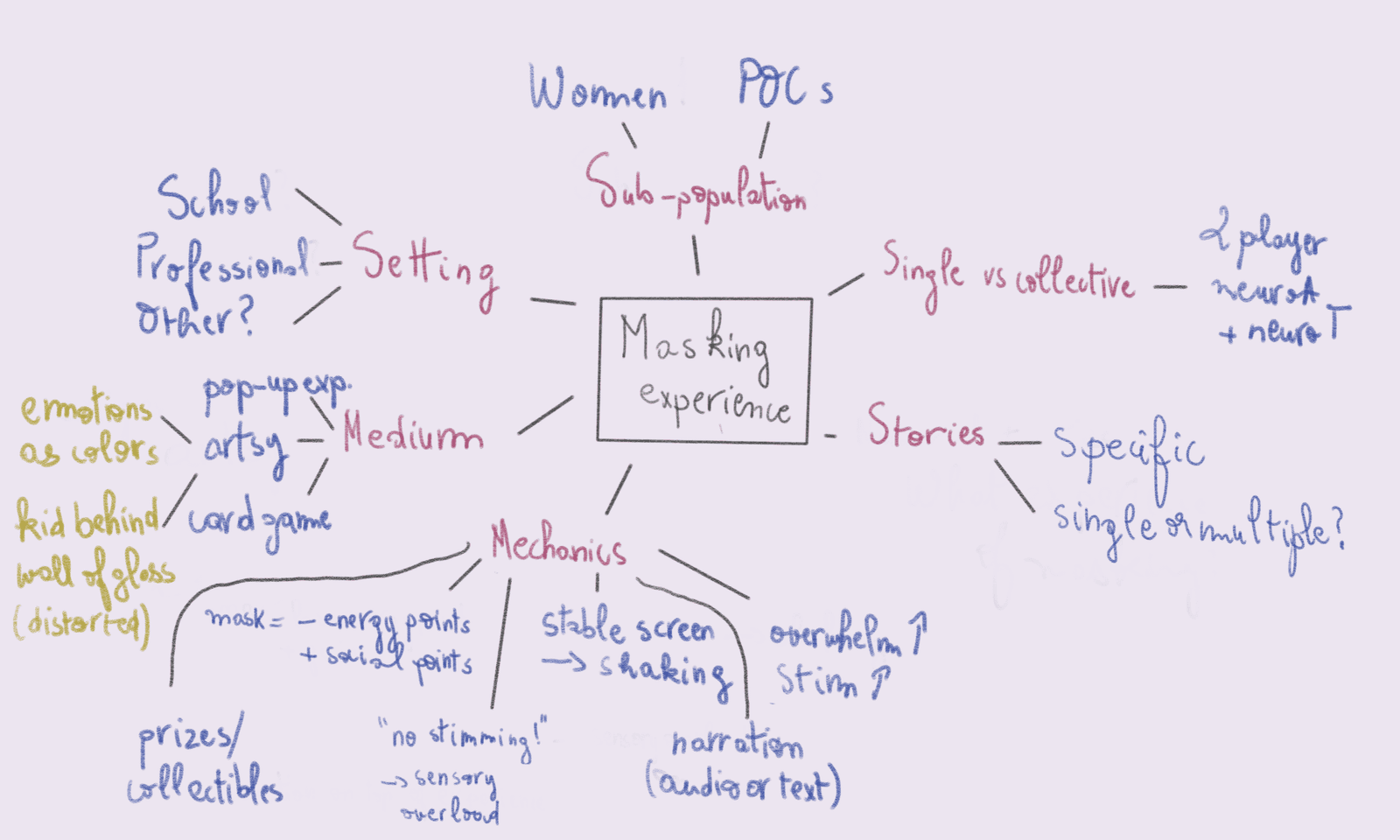
Mindmap
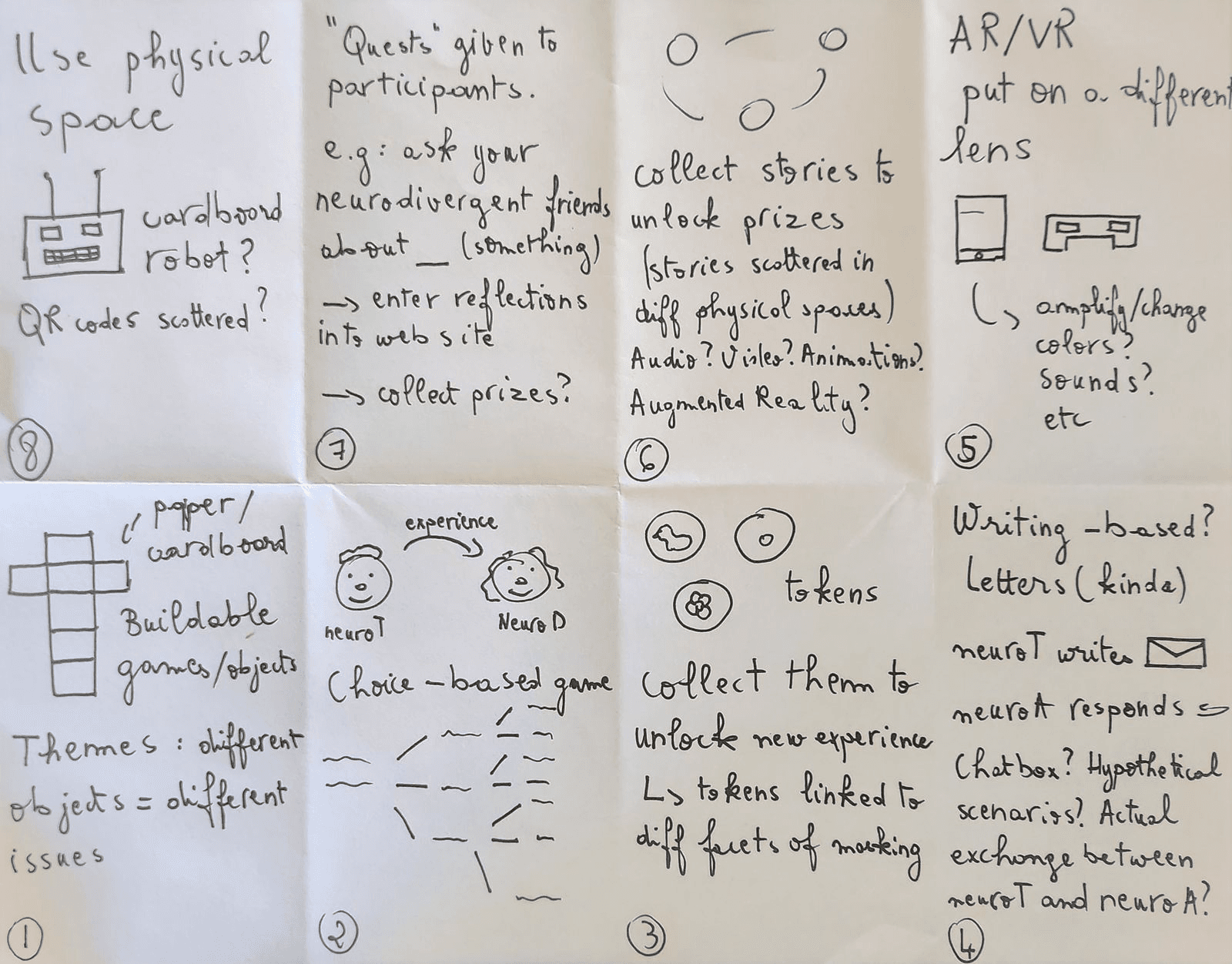
Medium/mechanics brainstorm
Choice. Solo, choice-based game (idea 2)
Reason 1: Choices available to neurodivergent folks in distressing situations may not be intuitively understandable to others. A primary function of games is to limit our agency to make us experience new types of agency we may not have experienced on our own (Nguyen, 2022)
Reason 2: The aim is to push the audience to reflect on their preconceived notions (or lack thereof) about neurodivergence. Narrative can embody cognitively rich emotional experiences of the world (Nussbaum, 1992)
Choosing a story
While listening to podcasts and broswing through lived experience, a specific line from an Understood podcast jumped at me: Emily's story with playing in snow as a child and feeling severely underwhelmed because of the gloves she wore. That experience forms the basis for what's to come.
And so, I started brainstorming and visualizing what the game could look like.

I even started breaking down the interactions!

Then I started worrying about some very specific details and...
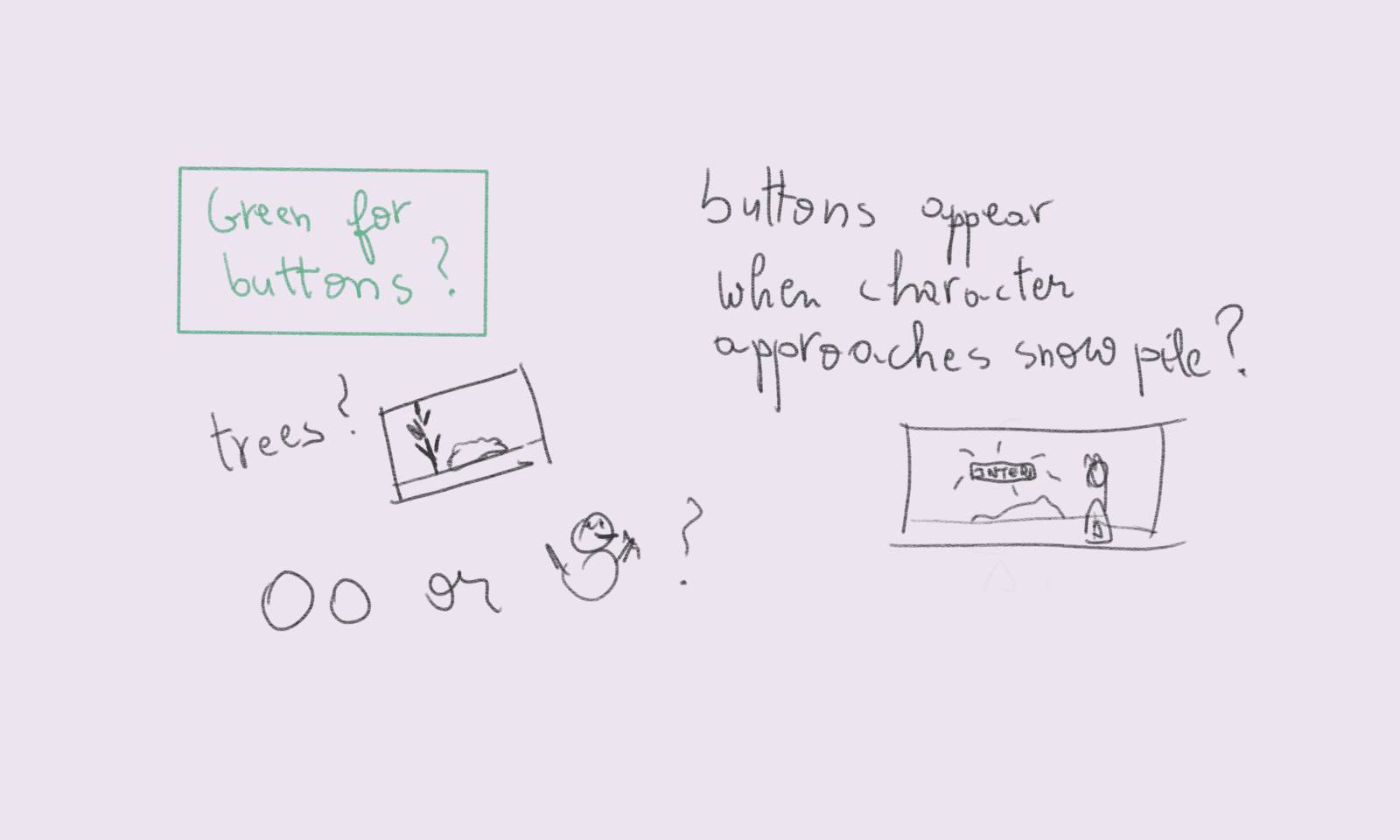
Realization after further reflection: ”Only prototype what you need to answer a question.”
What do I want to find out?
Overarching hypothesis. Does the game prompt empathy through constrained agency?
Narration strength. Are simple stories such as the one in the game emotionally resonant?
Impact of game mechanics. Does the audience understand that the screen gradually turning gray symbolizes dulled emotions?
Prototype 1: Playing in Snow
In action
Scrolls to the top of the page
Overview of game structure
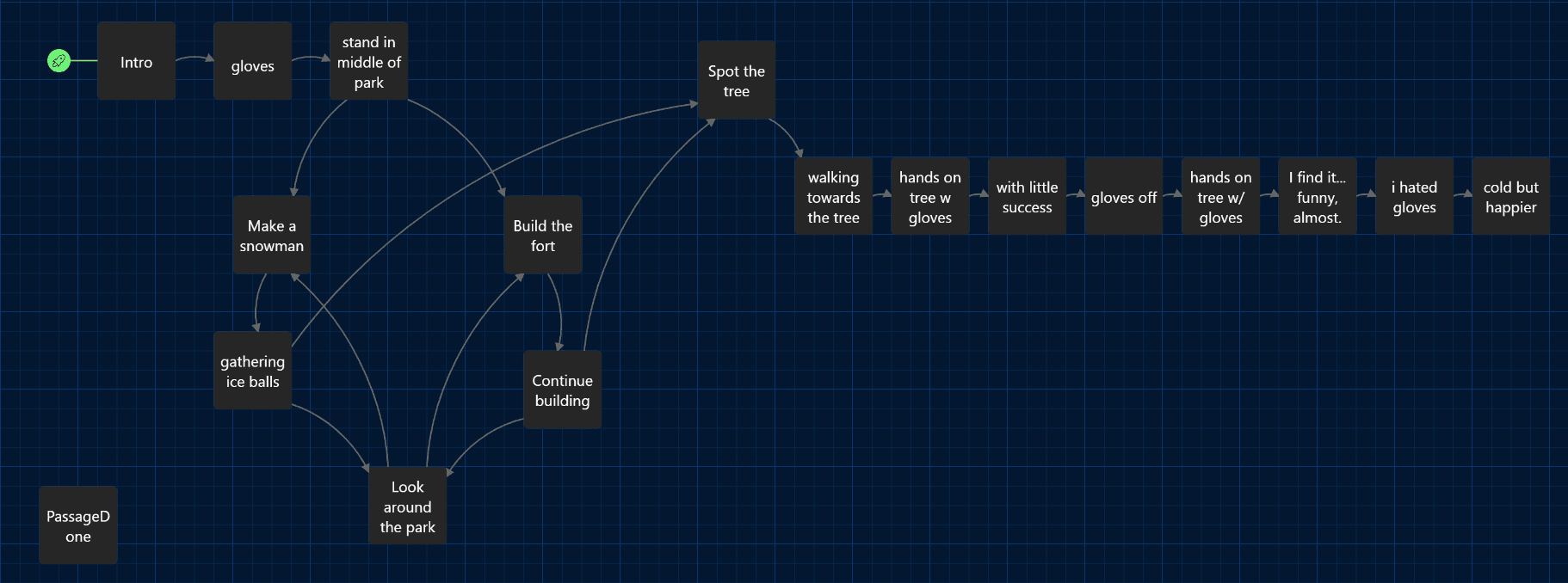
Testing prototype 1
Methodology
Minimally moderated walk-through with screen-sharing over Zoom. I only collected qualitative information.
Participants
4 undergraduate students aged 20-23 with varying levels of familiarity with games.
Summary of results
Feedback color key. Green: positive. Yellow: neutral/mixed. Red: negative.

Takeaways
Playtesting highlighted that constrained agency requires more than limited choice. It depends on meaningful, perceivable consequences. The absence of divergent outcomes limited the extent to which players experienced constraint.
The narrative format proved effective at prompting emotional resonance, with a caveat: it required a shared lived experience. Players who had played in snow as children related more strongly to the experience than others did.