

How might we design an experience that helps neurotypical young adults better understand the lived experiences of neurodivergent people?
Project overview
This is the second of two prototypes exploring how design can build empathy for neurodivergent experience. It was built on the findings of Playing in Snow, a solo experience. Mismatch, in contrast, is a live, collaborative game that explores how empathy can emerge through collective play. The game assigns each participant a constraint they have to respect while communicating with their group to solve a puzzle. Each constraint is designed to mimic a common struggle neurodivergent people face in everyday communication, making the consequences of those limitations felt in real time and revealing how invisible constraints impact group dynamics, agency, and effort.
Contributions
I led Mismatch end to end, from research synthesis and experience design to live facilitation and post-playtest analysis.
Timeline
Part 1 & 2. October 2024 - May 2025 (8 months, part-time)
Highlights
Agency emerged through interpretation. Constraints can increase agency when players are free to interpret and embody roles, rather than follow scripted actions.
Friction made common struggles felt. Shared constraints and role misalignment made communication barriers tangible, highlighting invisible labor (e.g., the effort made to hide neurodivergent traits)
Reflection unlocked meaning: Structured debriefs were essential in translating playful tension into important take-aways.
Part 1 recap
Already read Part 1: Playing in Snow?
Motivation
Neurodiversity. The idea that individuals perceive and engage with the world in diverse ways, recognizing that there is no single "correct" way to think, learn, or behave (Baumer & Frueh, 2021). Conditions include Autism, ADHD, dyslexia, and more.
Some statistics
Autistic people are more likely to die by suicide than non-autistic people, according to the past several years of research
TW — Suicide
The unemployment rate for neurodivergent people in the US is 30 to 40% compared to 10.1% of disabled people and a national average of 3.7% (John Hopkins University)
In 2021, the graduation rate at the University of California was 58% for neurodivergent students, compared to 79% for students without disabilities (Gauvain)
Why I care
As an experiential designer working with play and narrative, I’m exploring how design can surface invisible barriers and reshape how people understand one another. Neurodivergence is often discussed in terms of statistics, but rarely understood at a human level. I wanted to explore how design might help bridge that gap through lived, felt experience.
Research
After looking into the history and evolution of the neurodiversity movement and current discourse, I emerged with two key findings:
The Double Empathy Problem. The idea that neurodivergent people and neurotypical people struggle with understanding each other's ways of thinking. Formulated by Milton (2012).
The Empathy gap. The idea that much of the suffering that neurodivergent people face in various facets of their lives (e.g., access to education, medical bias, bullying) is due to the lack of empathy on behalf of the neurotypical majority. My formulation, after research
Double Empathy problem
Empathy gap
How might we design an experience to foster greater neurodivergence inclusion?
How might we design an experience that helps neurotypical young adults better understand the lived experiences of neurodivergent people?
Why neurotypical young adults?
Responsibility falls more heavily on neurotypical folks due to the history of stigma and marginalisation
Focused on young adults because they were the most accessible audience within the context of this project
Conclusions for Part 2
Part 1 featured a solo, choice-based narrative game as the prototype
The absence of divergent outcomes to choices limited the extent to which players felt a sense of agency. This second prototype will flip the script: it will give players very limited, specific constraints, and allow free actions
Prototype 1 carried the challenge of creating a relatable story for the audience. Prototype 2 will take the narration challenge out of the equation: it will not rely on a story
Prototype 1 was a solo experience, Prototype 2 will be a collective one
Design
I had the academic requirement of carrying this session out on Forum*, our active learning virtual platform at Minerva University. And so, this prototype had to be:
playable virtually
with the constraints of the platform (Forum*)
Suitable to a class of 12 students
* Forum works similarly to Zoom, with breakout rooms and the added possibility of working on documents collaboratively in the same window, as well as a limited set of reactions
Thinking through tools and constraints of Forum

Generating ideas then grouping them into the different facets of the experience
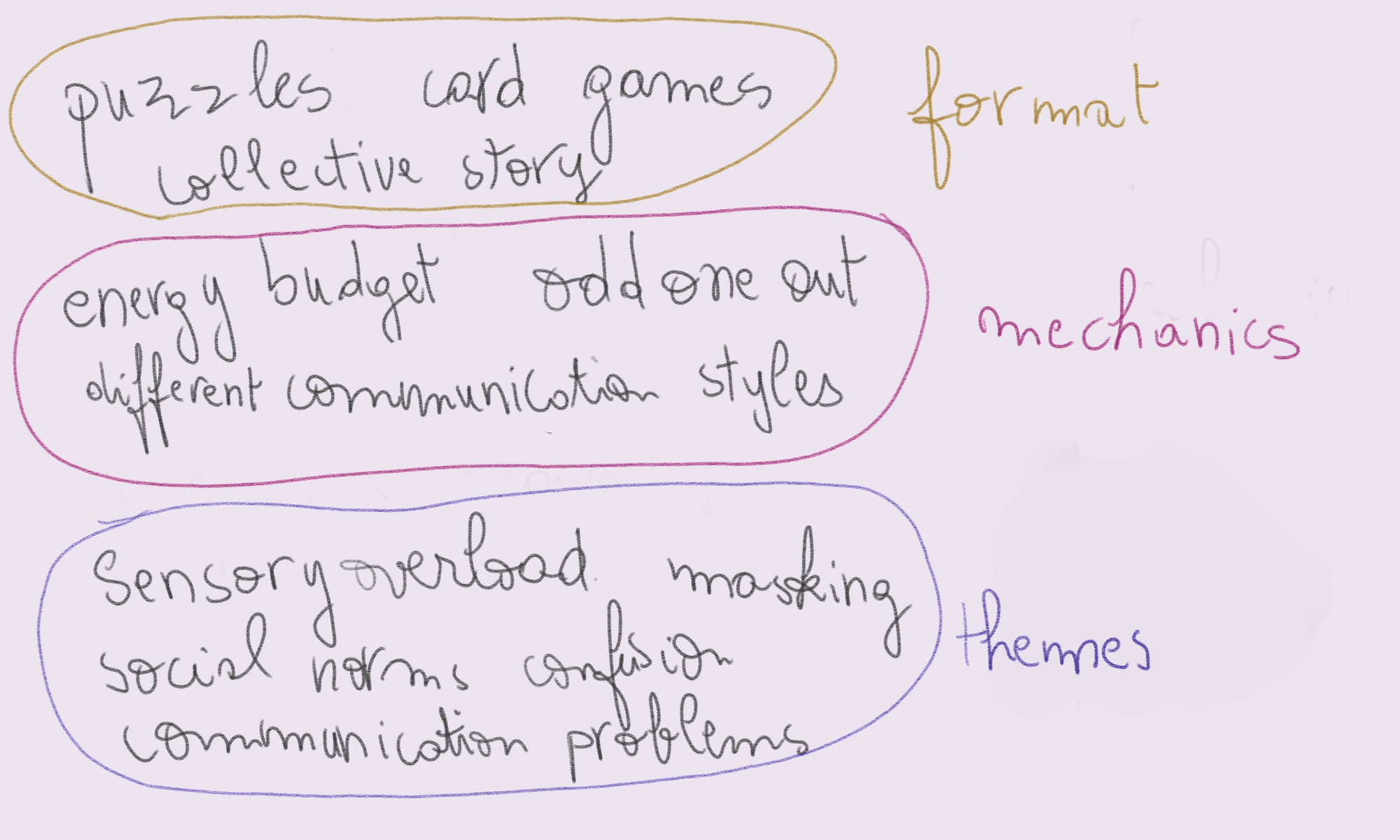
Inputting ideas into AI, shortlisting a few salient ideas
Premise: Explore communication differences.
Gameplay: Players are split into pairs. One can only communicate via emojis. The other can only speak in short phrases. They must work together to complete a visual or verbal puzzle (provided by GM).
Goal: Understand alternative communication strategies and challenges.
Premise: Everyone draws a unique "mind card" representing a different neurodivergent profile (e.g., ADHD with sensory sensitivity, autistic with high pattern recognition, dyslexic with strong spatial skills).
Gameplay: Players are given a task (e.g., planning a group trip or solving a puzzle). Each must approach the task from the lens of their assigned mind. Afterward, they reflect on what felt natural or hard.
Goal: Foster perspective-taking and empathy.
Prototype 2: Mismatch
Scrolls to the top of the page
Overview
“Mismatch” Communication Challenge
Premise: Explore communication differences.
Gameplay: 12 students split into 4 breakouts of 3 people. Each member of the breakout room will be given a different communication constraint (e.g., only emoji reactions, can only say one sentence, etc.) Every communication constraint will be inspired by a real communication challenge/style that neurodivergent folks face/have.
Goal: Understand common communication challenges faced by neurodivergent people in everyday life
Note. While the communication challenge given to each person is meant to mimic an issue that neurodivergent people face, in reality every challenge is multi-faceted and much more complex than what is presented within the game
Testing prototype 2
Methodology
Moderated run-through. I received general (and anonymous) feedback after the class and took notes throughout the process. I collected qualitative information.
Participants
12 undergraduate students split in 4 groups of 3.
Summary of results
Openness allowed personal interpretation of role. Because actions weren’t prescribed, participants could embody roles in ways that felt authentic to them, which deepened ownership and agency.
Ambiguity lowered agency for some. Without enough instructions, some groups floundered, which led to uneven participation. Clearer framing upfront could help players feel freer within constraints.
Differences make the most sense in relation to others. In a group setting, students experienced misalignment, frustration, and adaptation, which mirrors the real-life experiences of many neurodivergent folks thrust in social settings that abide by rules that clash with their communication style/challenges.
Takeaways
Part 1 and 2 combined revealed the following:
Meaningful constraints can generate empathy, but only when designed intentionally. In Playing in Snow, limited choice outcomes were a design limitation that reduced player agency and immersion. Mismatch flipped this: by giving players specific, purposeful communication constraints within a live social setting, invisible barriers became felt in real time. Constraints are often treated as limitations in design. Here, they became a mechanism for empathy. However, the insight isn't that constraints are always generative, it's that the right constraints, in the right context, can turn abstract differences into embodied experience.
Different formats generate different kinds of empathy. Playing in Snow created a quiet, internal experience: empathy through recognition, dependent on the player's capacity to relate to the story from their lived experience. Mismatch created a social, embodied experience: empathy through friction, felt in real time through interaction with others. Neither is superior. Together they suggest that the format of an experience shapes not just how empathy is felt, but what kind of empathy is possible.
Traditional informational methods (definitions, lectures, reading) teach conceptually, but design experiences shape perspective. They reconfigure how players relate to content inside themselves and in relation to others. Participants often knew about neurodivergence conceptually (what it means, what masking is), but both prototypes revealed that experiential engagement (feeling limited options, navigating ambiguity, communicating under constraint) made them feel closer to what being neurodivergent actually entails.